Based on Hunterbrook Media’s reporting, Hunterbrook Capital is long $GNRC and short a basket of comparable securities at the time of publication. Positions may change at any time. See full disclosures below.
You can get a backup generator for your house in a week. But if you’re building a billion-dollar data center, you might wait over two years — unless you buy from Generac ($GNRC).
And now, states — whose grids are being tested by an AI build-out with a seemingly insatiable appetite for power — are starting to require hyperscalers to install them.
Generator lead times from major players like Caterpillar, Cummins, and Rolls-Royce can stretch as much as 107 weeks. The companies constructing the most expensive AI infrastructure in history are scrambling for alternatives.
Enter: Baudouin — a French engine brand owned by Chinese conglomerate Weichai Group. Baudouin makes the engines that are the key component of multimegawatt backup generators like those used in major data centers, and in the United States, they are distributed most prominently as part of the new integrated generator systems put together by Generac.
One of Baudouin’s customers?
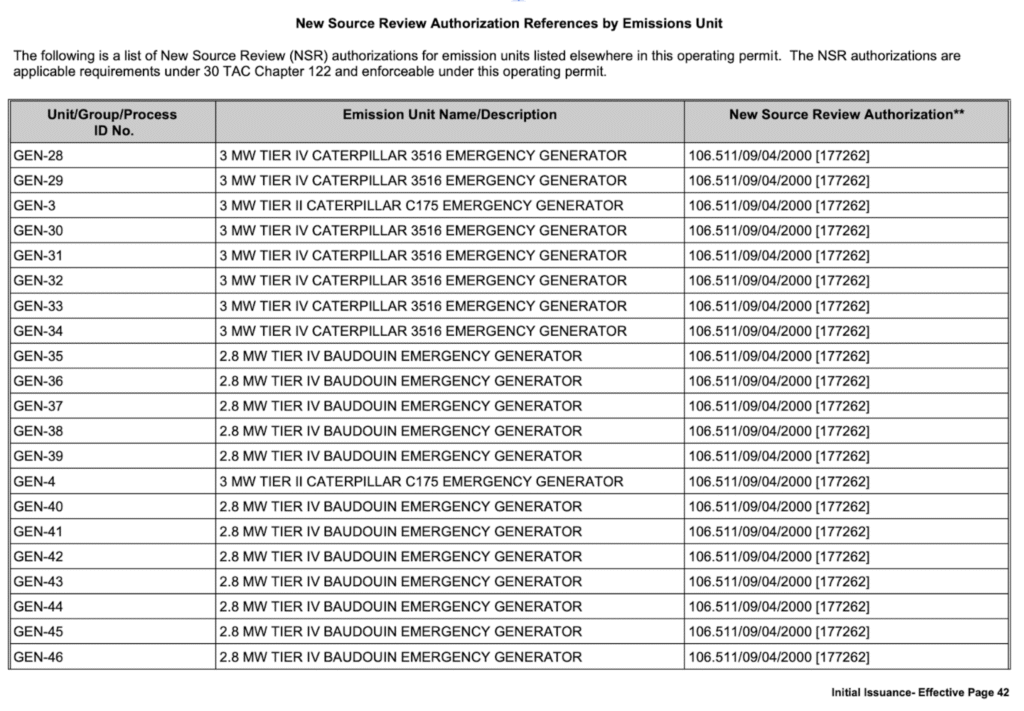
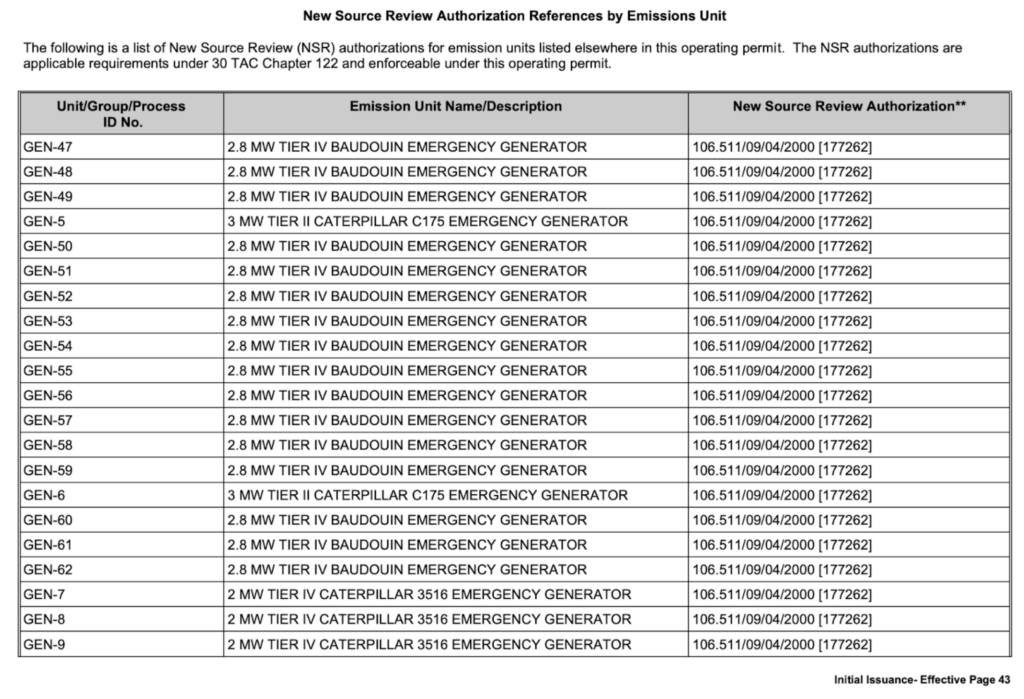
The Stargate data center in Abilene, the crown jewel of the $500 billion AI build-out from SoftBank, OpenAI, Crusoe, and Oracle. This is according to an obscure section of a Texas air permit reviewed by Hunterbrook. Buried on pages 42 and 43: 28 emergency backup generators powered by Baudouin.
The Stargate permit doesn’t name the company set to package the Baudouin engines into finished generators — but there aren’t many options. Baudouin has a sparse distribution network in the United States, consisting largely of marine engine shops: a small LLC in Washington State, a boat repair company in Florida, you get the idea.
The only two Baudouin distributors to data centers identified by Hunterbrook are IGSA Power — a relatively small Mexico-based manufacturer with an office in Laredo, Texas — and Generac. Another company, Winco, claims to provide generators to data centers. We could not identify any. The company lists a golf course as the case study on its website. Asked whether it sells to Stargate, a sales representative said he could neither confirm nor deny it. When we called Winco on the phone, the company didn’t seem to have heard of Stargate at all. Baudouin itself also appears to offer generator sets suitable for data centers, which it manufactures in France and China. The company says its generators “comply with strict U.S. emissions standards,” but a Hunterbrook analysis of trade data showed that Baudouin and its parent company Weichai did not import generator sets for data centers, only engines, spare parts and other goods, to the U.S.
Sign Up
Breaking News & Investigations.
Right to Your Inbox.
No Paywalls.
No Ads.
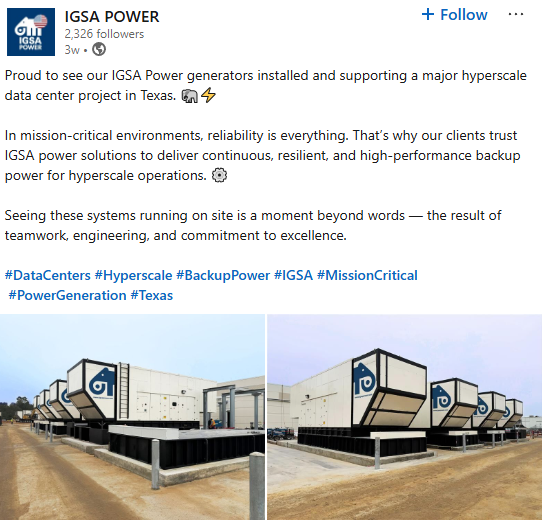
Based on reporting by Hunterbrook Media, it appears that IGSA may be supplying at least some of the 28 Baudouin units at the Abilene site, potentially through an intermediary. The trail we followed: IGSA Power, which sells generator sets with Baudouin engines, posted on LinkedIn that it is live at a hyperscaler in Texas. Hunterbrook Media confirmed this location is not Stargate but found it noteworthy nonetheless given some reports that Generac had an exclusive deal with Baudouin. In calls to IGSA’s Laredo, Texas, office, a Hunterbrook reporter found that an IGSA representative recognized the name Crusoe and referenced an order of generators. The representative also referenced “Abilene DC3, DC4, DC8” in connection with the order. Separately, Hunterbrook discovered that the entity representing Stargate on the Abilene generator permit is Abilene DC 1, LLC — a naming convention consistent with the “DC3, DC4, DC8” designations referenced by IGSA. This suggests IGSA is involved in supplying Baudouin generators to Crusoe-affiliated data center projects in the Abilene area; on another call, an IGSA employee directed Hunterbrook to Network Environments.
But the bigger story is what may come next.
The Stargate build-out alone envisions nearly 10 gigawatts of capacity, even with recent reporting from The Information indicating OpenAI won’t lead the build out itself. The backup generation required to support that — thousands of large-megawatt units — is well beyond what a small company like IGSA has demonstrated it can deliver.
Which raises the question: Who scales Baudouin in America?
The answer, almost certainly, is Generac — the $13 billion Wisconsin company known to Wall Street as the stock that dips and rips around hurricanes. The almost 70-year-old company is the “Kleenex” of backup power, a name synonymous with those suitcase-shaped boxes sitting in suburban backyards that hum to life during a storm.
Whereas IGSA manufactures around 2,000 units per year, across various generator sizes and engine brands, Generac sells an estimated 800,000 generators annually. Generac does not disclose unit sales in its financial statements, so we derived an estimate from its 2025 10-K filing. We started with the company’s reported net sales by product class — $2.27 billion in residential products and $1.46 billion in commercial and industrial products — then estimated what share of each category represents actual generator revenue versus non-generator items like energy storage, light towers, and controls. We applied representative per-unit pricing based on Generac’s published MSRPs, adjusted downward to approximate wholesale net sales prices, and divided to arrive at estimated unit volumes. Our central estimate is roughly 800,000 generators sold in fiscal year 2025, with a plausible range of 630,000 to 1 million units depending on assumptions about product mix and average realized pricing.
And as the AI boom turns electrical power into a scarce commodity, Generac’s suburban and rural identity is undergoing a metamorphosis. Generac has struck a major deal with Baudouin to partner on data center generators — launching a new product line last April; building a $400 million backlog in under a year; and racing to double its manufacturing capacity. The company has redesigned its plant in Oshkosh, Wisconsin, specifically to build its data center generator lineup and moved production of some smaller generators to a new facility in Beaver Dam.
For all these reasons, Generac seems to be on its way to becoming by far the largest U.S. distributor of the Baudouin brand — while other generator manufacturers are already booked out for years.
In a podcast, Ricardo Navarro, Generac’s senior VP & general manager of global telecom and data centers, said the company is moving much faster than competitors. Generac delivers certain offerings within around 30 weeks. “If you compare that to the current supply of existing OEMs, it’s one third of that lead time,” he said. “Everyone is interested in that.”
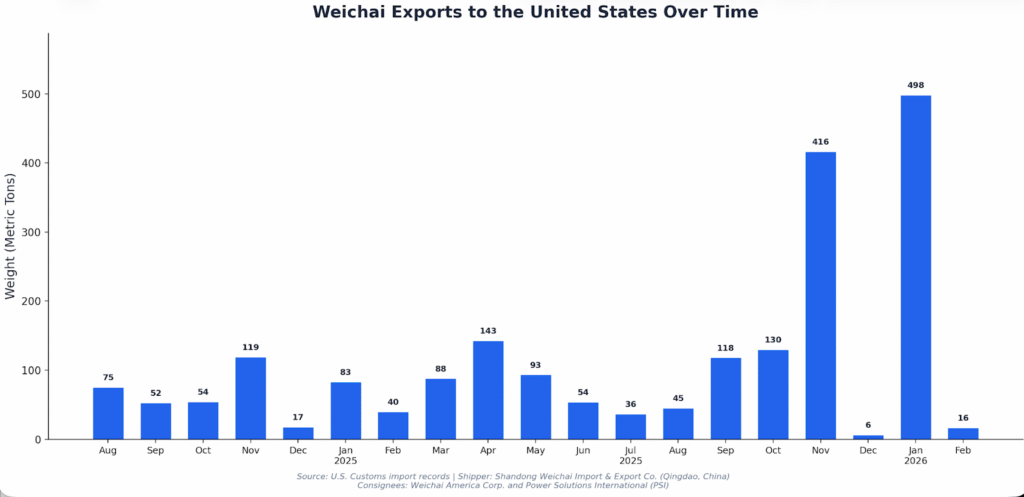
Trade data supports Navarro’s description of demand. In recent months, Weichai’s shipments to the United States have soared — amid what Andrew A. Chien, a computer science professor at The University of Chicago who studies data center infrastructure, described as a “power rush” in an interview with Hunterbrook.
Of the hyperscalers, Chien said: “They’re probably trying to get everything they can get.”
Investing in backup generators, in particular, may soon become a legal necessity for data center operators across the United States.
Look at Texas, which passed a law that has transformed backup power into a cost of doing business.
Last June, the Lone Star state — now poised to be the largest data center market in the country — enacted Senate Bill 6, requiring new or expanded facilities drawing 75 megawatts or more from the grid to be prepared to curtail their loads or activate on-site backup generation during emergencies.
Facilities that connected after December 31, 2025 must install remote-disconnect equipment allowing the grid operator, ERCOT, to cut them off. (Asked about Stargate, ERCOT declined to comment on any specific ongoing project.)
The law was tested almost immediately.
During Winter Storm Fern in January, the Department of Energy issued an emergency order authorizing ERCOT to direct data centers to fire up their backup generators. The practical effect is that major data centers in Texas now need to curtail load when the grid is pushed past its limits — potentially threatening active training runs — or turn on a fleet of large-megawatt generators like the ones produced by Generac. For companies that can deliver those generators faster than anyone else, the demand is structural.
And Texas is just the beginning.
U.S. data centers consumed roughly 25 gigawatts of power in 2024; by 2030, that figure is expected to reach somewhere between 50 and 100 gigawatts. As the Generac CEO put it in an interview on CNBC: “That’s like adding 20 New York Cities.”
Six states — including New York, Virginia, and Georgia — have introduced moratorium bills to pause new data center construction, and local governments in at least 14 states had enacted their own moratoriums by the end of 2025.
The political message is clear: Data centers must bring their own power and stop burdening the grid. That could be very good news for backup generator manufacturers like Generac.
The Permit
The discovery of OpenAI’s embrace of Baudouin generators comes five months after Hunterbrook Media and Citrini Research flew a drone over the Stargate data center campus in Abilene, Texas. The footage went viral, revealing a facility the size of Lower Manhattan rising from the red Texas clay: eight massive AI computing halls, backed by natural gas turbines from GE Vernova and Caterpillar.
What the flyover didn’t capture — because none of the emergency backup generators appear to have been delivered yet — was Baudouin’s presence.
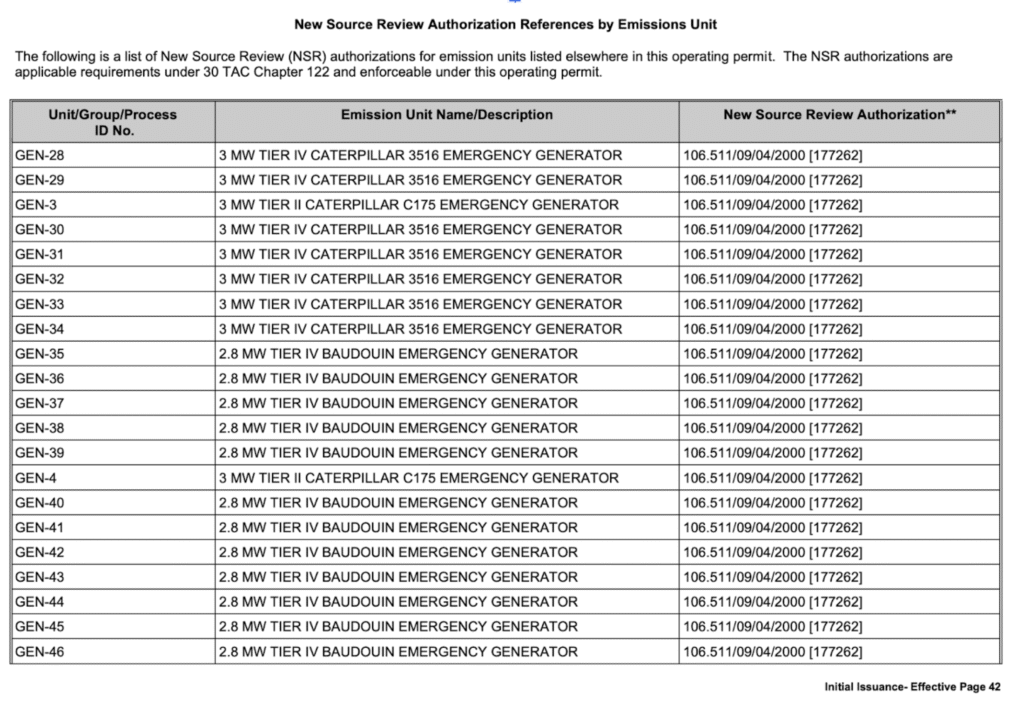
The January operating permit lists 62 emergency generators at the Longhorn Data Center: 34 Caterpillar units and 28 Baudouin units, providing roughly 170 megawatts of total backup capacity. The 28 Baudouin generators, listed as GEN-35 through GEN-62, are each rated at 2.8 megawatts and classified as Tier IV emergency units. Together they represent approximately 78 megawatts of backup power — enough for 60,000 average homes or nearly half the emergency generation capacity outlined in this permit at one of the most closely watched AI infrastructure projects in the world.
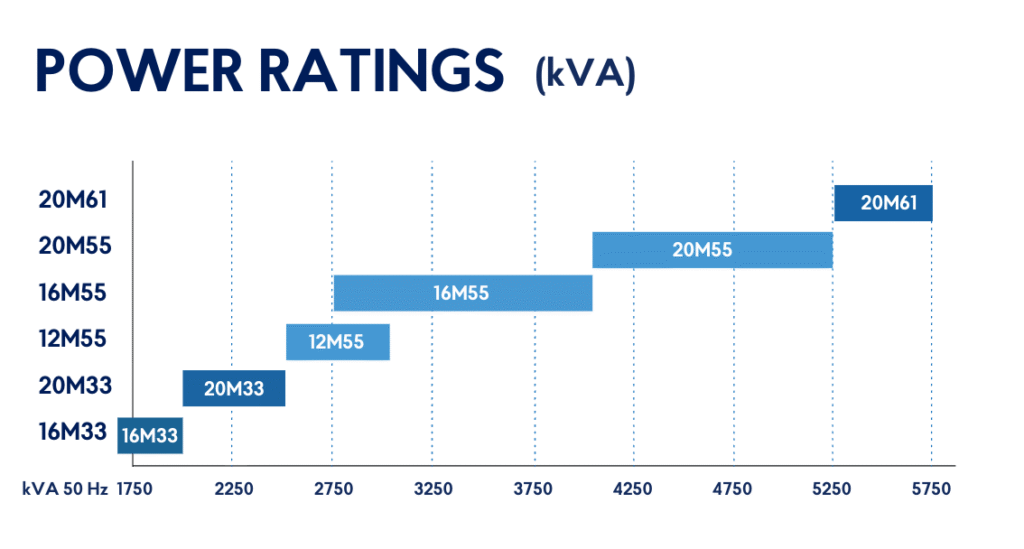
This aligns with the specs of Generac’s generators — which launched back in April. The company released a full lineup of five models, ranging from 2.25 to 3.25 megawatts, all built on the Baudouin M55 engine platform.

One discrepancy: Generac’s published spec sheet for the SD2750/MD2750 lists the Baudouin engine as EPA Tier 2, rated at 2,750 kW — while the permit classifies the Baudouin units as Tier IV at 2,800 kW. But this gap may not be meaningful. Generac’s own product materials describe the lineup as “ready for use with compliant Tier 4 aftertreatment systems,” meaning the same base engine can meet different emissions tiers depending on configuration. (IGSA, for its part, is also labeled as Tier 2, indicating that isn’t a barrier to entry.) And based on Baudouin documents, each of their engines can power up from the name-plated capacity.
The Caterpillar fleet at the same site demonstrates the same pattern — 3516 engines appear in the permit in both Tier II and Tier IV variants.
All in all, it’s a modest amount of backup power, according to Chien, the computer science professor. “I heard a rumor that they were going to go with less than full backup power at that site,” he said. “Normally, if they have a gigawatt of IT equipment, they’ll have a gigawatt of backup. But … that might be because they can accept the unreliability — because it is pretty rare that the grid goes down — or they couldn’t get the generation.”
Still, Stargate could pose environmental concerns, according to Damian Pitt, associate professor of urban and regional studies and planning at Virginia Commonwealth University.
“Whenever they are running, they will be producing air pollution in the form of nitrous oxide, particulate matter, carbon monoxide, sulfur dioxide, and so on that would diffuse into nearby neighborhoods,” Pitt said. “And if there are people living in those areas, then they could be exposed to air pollution impacts.” Stargate — the largest project — is not particularly close to any residential areas, but Hunterbrook and others have scrutinized the proximity of similar industrial facilities to residential neighborhoods. Read our recent reporting on Indorama.
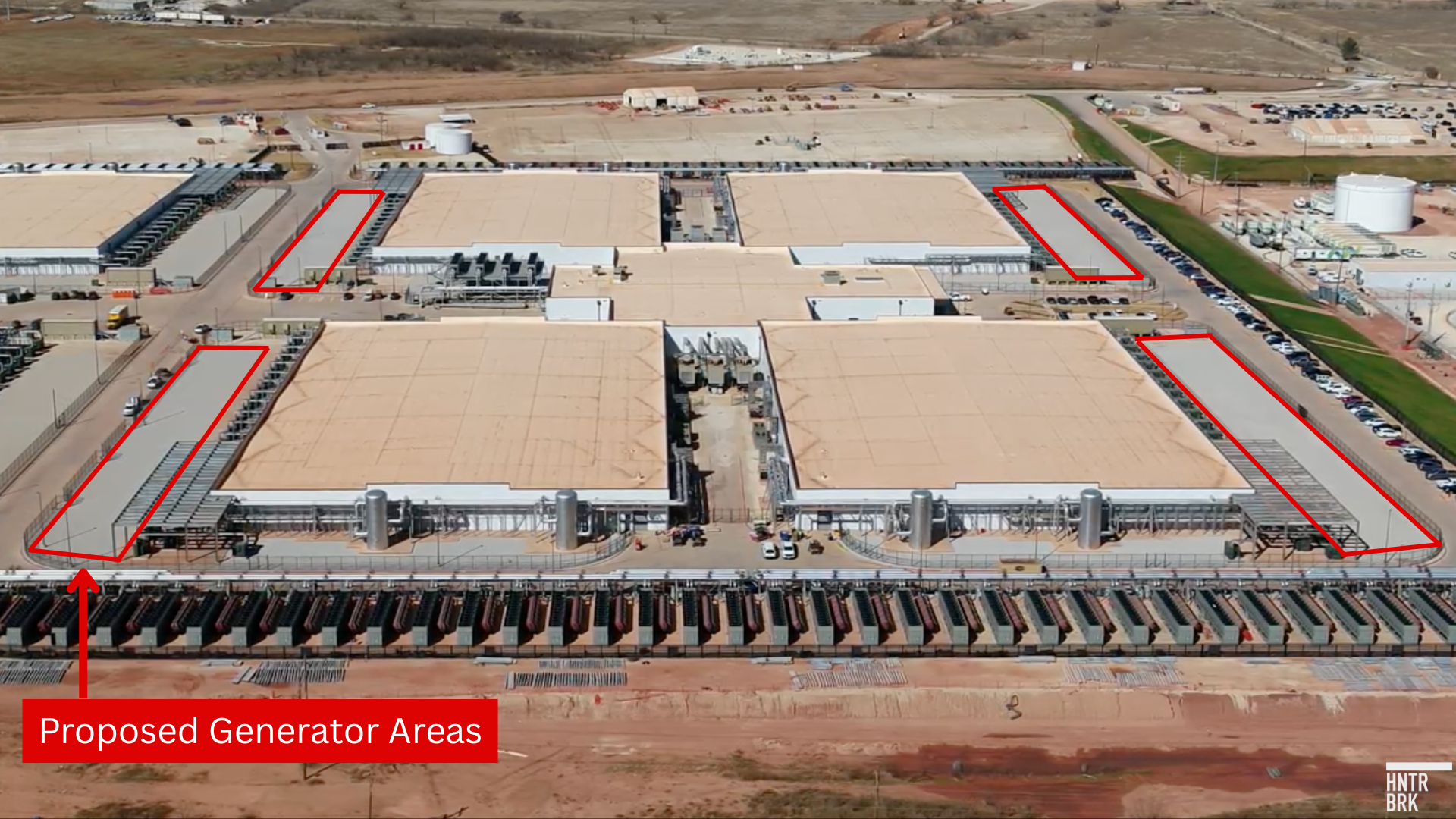
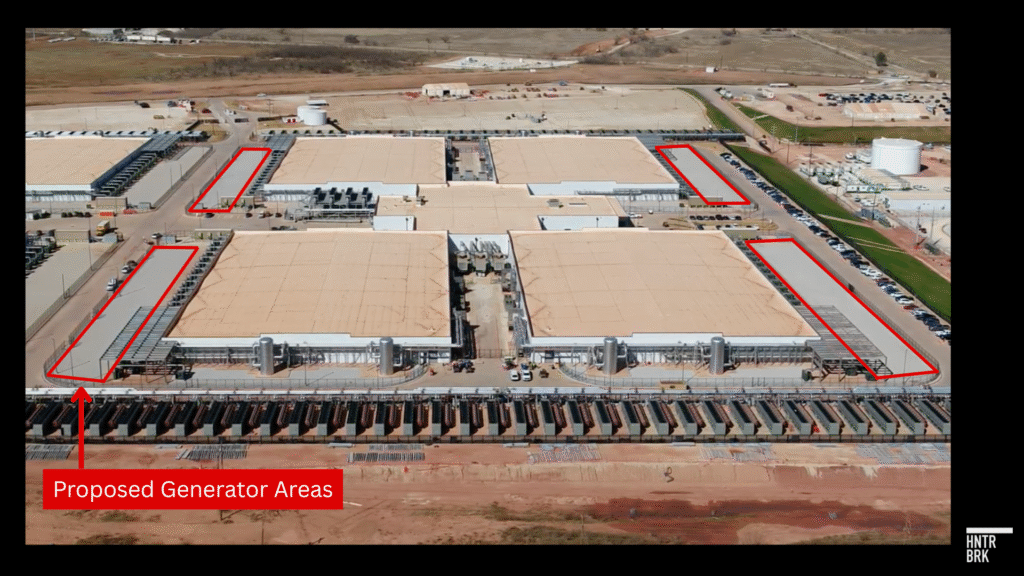
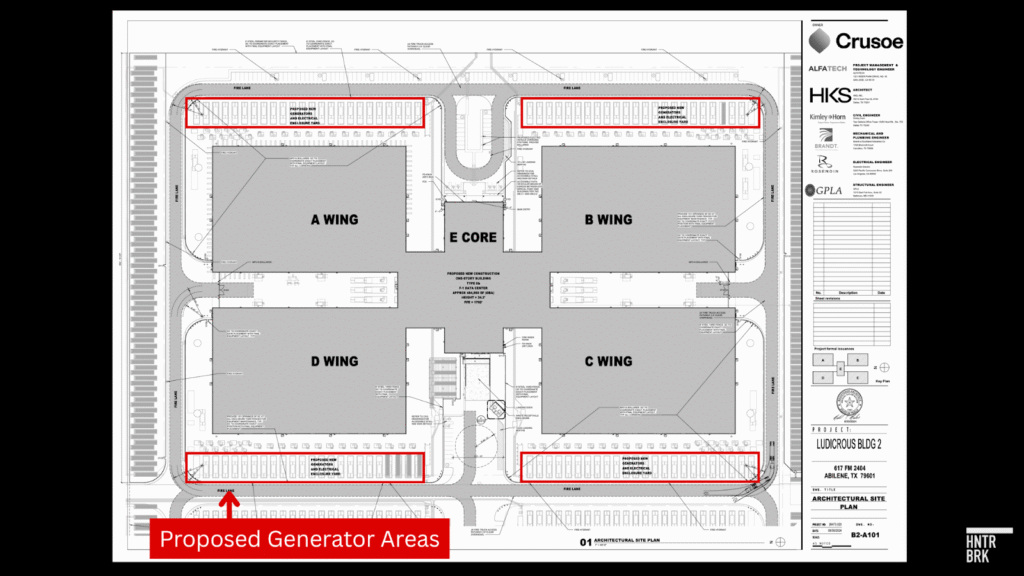
And the existing permits may only be for a fraction of what ends up being the total number of generators needed at Stargate. So far, the designated area for generators — according to public plans — remain empty, according to a review of recent satellite and aerial imagery.
Scale
TD Cowen has described Generac as having “exclusive U.S. access” to Baudouin engines for data center applications. But that characterization may overstate the arrangement — IGSA Power also sells Baudouin-powered generators in the U.S. and appears to have placed units at least one Texas data center. Late last month, IGSA shared a pair of images mentioning a major installation at a new data center project in Texas.
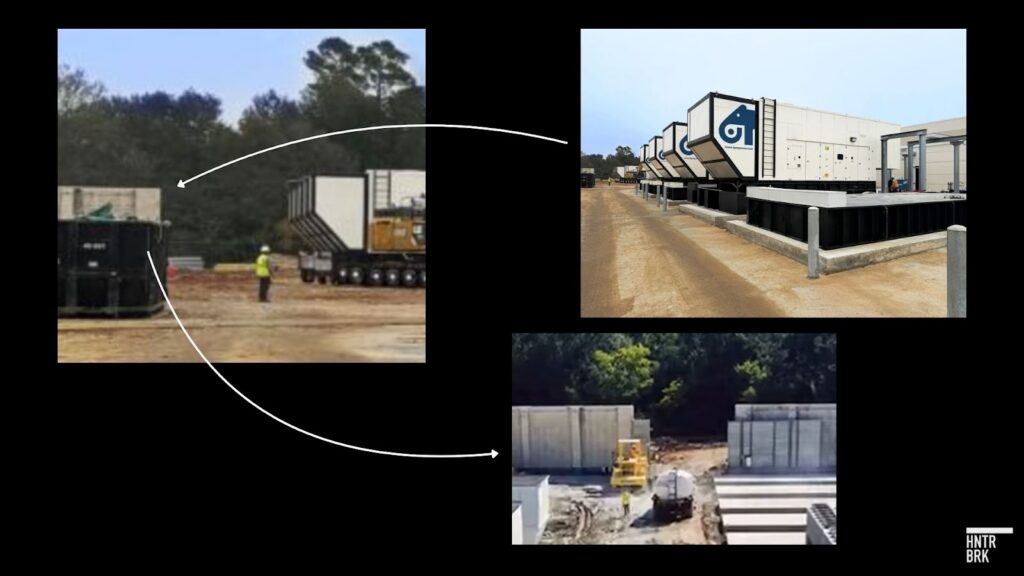
Hunterbrook analyzed the images IGSA shared and geolocated them not to Stargate, but to a multi-unit generator installation at Serverfarm’s CTX2 data center in Houston. By comparing tree lines, concrete pads, and distinctive wall structures across more than 20 newly built or recently commissioned data centers in Texas, we found a clear match to footage previously released by Serverfarm in a promotional video last year.
Generac did not respond to repeated requests for comment on the scope of its Baudouin distribution rights.
While boutique vendors may fulfill individual orders, the sheer magnitude of the Stargate build-out requires an industrial muscle that only a company of Generac’s size can provide. IGSA has between 200 and 500 employees, according to LinkedIn. Generac has roughly 9,000 — and they are working on building out the capacity to produce more than a billion dollars worth of data center generators annually starting next year.
On its earnings call last week, Generac described 2026 as an “inflection point” for its data center business. CEO Aaron Jagdfeld said to investors: “We further developed partnerships in the quarter with multiple hyperscalers, including progressing to the pilot phases of our relationships with two specific customers as we prepare for potential significant volumes in 2027 and 2028.”
Jagdfeld told analysts the $400 million backlog was built almost entirely from orders placed by colocators and developers — meaning these estimates exclude any potential revenue after the hyperscaler pilots.
If those convert to long-term supply agreements, the implications are substantial. Jagdfeld has estimated the total addressable market for large-megawatt generators at $15 billion annually and has set a target of capturing 10%-15% of that market — implying at least $1.5 billion in annual data center revenue alone, which would roughly double the company’s current commercial and industrial business.
To support this, Generac is scaling manufacturing capacity aggressively. Jagdfeld acknowledged on the Q4 call that the company took a bit of a “risk” expanding ahead of signed hyperscaler contracts — but said projected volumes for 2027 and 2028 could take them “easily above” $1 billion in capacity.
Jagdfeld projected that order intake would “accelerate over the next several quarters,” adding: “We are making progress with other data center colocators and developers.”
What Generac didn’t say on that earnings call: The most prominent data center build-out in the world has already permitted for the exact generator engines they sell.
Authors
Sam Koppelman is a New York Times best-selling author who has written books with former United States Attorney General Eric Holder and former United States Acting Solicitor General Neal Katyal. Sam has published in the New York Times, Washington Post, Boston Globe, Time Magazine, and other outlets — and occasionally volunteers on a fire speech for a good cause. He has a BA in Government from Harvard, where he was named a John Harvard Scholar and wrote op-eds like “Shut Down Harvard Football,” which he tells us were great for his social life.
Till Daldrup joined Hunterbrook from The Wall Street Journal, where he focused on open-source investigations and content verification. In 2023, he was part of a team of reporters who won a Gerald Loeb Award for an investigation that revealed how Russia is stealing grain from occupied parts of Ukraine. He has an M.A. in Journalism from New York University and a B.S. in Social Sciences from University of Cologne. He’s also an alum of the Cologne School of Journalism (Kölner Journalistenschule).
Andrew Ford is an investigative journalist who exposed systemic flaws and prompted reforms in healthcare, business, policing, and state government. His reporting was published by ProPublica, USA Today, The Arizona Republic, Asbury Park Press, and Florida Today. He holds a journalism bachelor’s from the University of Florida and is based in Phoenix, AZ.
Blake Spendley joined Hunterbrook from the Center for Naval Analyses (CNA), where he led investigations as a Research Specialist for the Marine Corps and US Navy. He built and owns the leading open-source intelligence (OSINT) account on X/Twitter, called @OSINTTechnical (over 1 million followers), which also distributes Hunterbrook Media reporting. His OSINT research has been published in Bloomberg, the Wall Street Journal, and The Economist, among other top business outlets. He has a B.A. in Political Science from USC.
Editors
Jim Impoco is the award-winning former editor-in-chief of Newsweek who returned the publication to print in 2014. Before that, he was executive editor at Thomson Reuters Digital, Sunday Business Editor at The New York Times, and Assistant Managing Editor at Fortune. Jim, who started his journalism career as a Tokyo-based reporter for The Associated Press and U.S. News & World Report, has a master’s in Chinese and Japanese History from the University of California at Berkeley.
Hunterbrook Media publishes investigative and global reporting — with no ads or paywalls. When articles do not include Material Non-Public Information (MNPI), or “insider info,” they may be provided to our affiliate Hunterbrook Capital, an investment firm which may take financial positions based on our reporting. Subscribe here. Learn more here.
Please email ideas@hntrbrk.com to share ideas, talent@hntrbrk.com for work, or press@hntrbrk.com for media inquiries.
LEGAL DISCLAIMER
© 2026 by Hunterbrook Media LLC. When using this website, you acknowledge and accept that such usage is solely at your own discretion and risk. Hunterbrook Media LLC, along with any associated entities, shall not be held responsible for any direct or indirect damages resulting from the use of information provided in any Hunterbrook publications. It is crucial for you to conduct your own research and seek advice from qualified financial, legal, and tax professionals before making any investment decisions based on information obtained from Hunterbrook Media LLC. The content provided by Hunterbrook Media LLC does not constitute an offer to sell, nor a solicitation of an offer to purchase any securities. Furthermore, no securities shall be offered or sold in any jurisdiction where such activities would be contrary to the local securities laws.
Hunterbrook Media LLC is not a registered investment advisor in the United States or any other jurisdiction. We strive to ensure the accuracy and reliability of the information provided, drawing on sources believed to be trustworthy. Nevertheless, this information is provided "as is" without any guarantee of accuracy, timeliness, completeness, or usefulness for any particular purpose. Hunterbrook Media LLC does not guarantee the results obtained from the use of this information. All information presented are opinions based on our analyses and are subject to change without notice, and there is no commitment from Hunterbrook Media LLC to revise or update any information or opinions contained in any report or publication contained on this website. The above content, including all information and opinions presented, is intended solely for educational and information purposes only. Hunterbrook Media LLC authorizes the redistribution of these materials, in whole or in part, provided that such redistribution is for non-commercial, informational purposes only. Redistribution must include this notice and must not alter the materials. Any commercial use, alteration, or other forms of misuse of these materials are strictly prohibited without the express written approval of Hunterbrook Media LLC. Unauthorized use, alteration, or misuse of these materials may result in legal action to enforce our rights, including but not limited to seeking injunctive relief, damages, and any other remedies available under the law.