
Based on Hunterbrook Media’s reporting, Hunterbrook Capital is short $NUAI at the time of publication. Positions may change at any time. See full disclosures below.
This holiday season, the energy company New Era Energy & Digital ($NUAI) got a lump of coal.
New Mexico Attorney General Raúl Torrez just filed a sweeping enforcement lawsuit seeking to bar New Era from conducting business in New Mexico until certain conditions are met. The requirements include paying civil damages and penalties. This litigation collides with the company’s push to develop a large, energy-intensive AI data center in the state.
The lawsuit accuses New Era, its chief executive Everett Willard Gray II, and a network of affiliated companies of orchestrating a fraudulent oil-and-gas scheme. Allegedly, the defendants sought to siphon revenue from wells that produce fossil fuels while abandoning environmental cleanup obligations.
New Era has not publicly responded, including to repeated requests for comment from Hunterbrook.
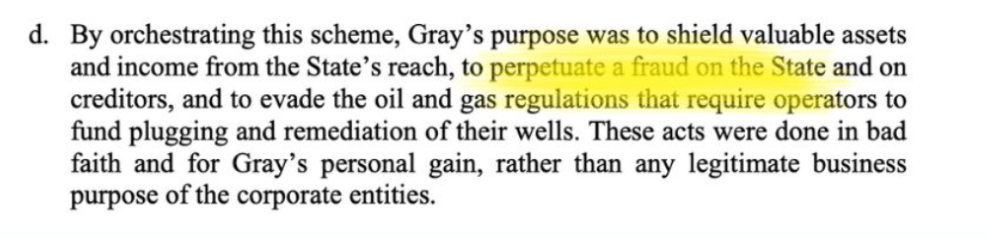
While the case involves hundreds of unplugged and inactive wells, the Attorney General emphasized that the lawsuit is not merely an environmental enforcement action. Instead, the complaint alleges a broader pattern of fraudulent transfers, self-dealing, and false statements to regulators, including the use of shell entities and strategic bankruptcies to evade responsibility.
The filing notes that New Era was formerly known as New Era Helium, and that the company rebranded to New Era Energy & Digital in 2025 while continuing to rely on those producing gas assets.
“New Era’s sole revenue source is its producing gas wells in New Mexico, which are composed, in part, of the gas wells Solis Partners received from Remnant via Acacia,” reads the lawsuit, referring to a series of companies tied to the alleged scheme.
Several of the entities named in the complaint were controlled directly by Gray, who purportedly deployed them in an elaborate corporate shell game. The scheme left New Mexico holding the bag and responsible for the plugging costs associated with hundreds of wells, the Attorney General alleges.
Alleged Scheme and Chapter 7 Backdrop
According to the New Mexico Department of Justice, the defendants were “fraudulently scheming to pocket revenues from hundreds of oil and gas wells in New Mexico” by transferring wells among related entities, “selling” wells to themselves, and then placing liability-bearing companies into bankruptcy to avoid plugging and remediation costs.
The lawsuit is being brought while Acacia Operating Company, LLC and Acacia Resources, LLC — two central entities in the alleged scheme — are already in Chapter 7 liquidation. New Mexico alleges that the bankruptcies were not incidental, but rather part of the scheme itself: Once regulatory pressure mounted, the defendants allegedly left Acacia underfunded and insolvent, allowing it to liquidate while environmental liabilities fell to the state.
As of September, Acacia Operating Company was listed as the operator for 219 inactive wells, all of which still require plugging and remediation, according to the complaint. (“The exact number of inactive wells has increased since September to 383 inactive wells,” reads a footnote in the complaint.)
Under New Mexico law, operators must plug and remediate wells at the end of their productive lives. When operators default, the state must step in — at an average cost of roughly $163,000 per well, the Attorney General said. The state’s lawsuit seeks payment from New Era, its CEO, and related entities.
How Gray Allegedly Masterminded the Scheme
The complaint places Everett Willard Gray II at the center of the alleged activity, portraying him as the mastermind and primary beneficiary of the scheme.
According to the lawsuit, Gray was a founder and CEO of the original Remnant companies, a managing member behind Solis Partners, and the CEO of New Era Helium — now New Era Energy & Digital — creating what the state describes as a continuous chain of insider control across each stage of the alleged asset transfers. ProPublica reported that Remnant failed due to “regulatory violations, bad bets and the oil fields’ age,” leading to bankruptcy as “its leadership shuffled assets and liabilities between companies the executives managed.”
The complaint alleges that Gray formed Solis Partners in June 2020 “to receive Remnant’s best wells,” at the same time his partners formed Acacia to take on Remnant’s marginal and inactive wells, “thus ensuring that Acacia would not be able to meet its environmental obligations.”
New Mexico further alleges that the most valuable gas wells — 87 in total — were transferred from Acacia to Solis Partners, an entity the complaint says was “dominated and controlled” by Gray, leaving Acacia with the bulk of plugging and remediation liabilities.
The complaint states that the bill of sale for those 87 gas wells listed a purchase price of just “$10,” and that it is “currently unknown what consideration Acacia actually received” for the transfer.
The lawsuit alleges that Gray believed Remnant owed him at least $400,000, and that the transfer of the 87 gas wells was intended to satisfy that alleged insider debt, even though the debt was not disclosed or resolved in Remnant’s bankruptcy proceedings.
“At the time of the C-145 application, Gray attempted to conceal his involvement in Solis Partners by directing Joel Solis to sign on behalf of Solis Partners,” the complaint alleges.
C-145 is an application to change the operator of a well.
According to the lawsuit, the New Mexico Oil Conservation Division approved the transfer of the 87 gas wells on Feb. 2, 2022, unaware that Solis Partners was controlled by a Remnant insider, and unaware that the transfer would deprive Acacia of a key revenue source.
The complaint alleges that Gray began drawing a salary of $273,000 per year from Solis Partners early that same year, and later received $475,000 per year as CEO of New Era, while revenues from the transferred gas wells continued to flow through Solis and into New Era’s corporate structure.
“Gray dominated and controlled Solis Partners since its inception … and Solis Partners is an alter ego of Gray,” the complaint alleges.
New Mexico also alleges that Gray orchestrated a reorganization under which Solis Partners became a wholly owned subsidiary of New Era, and that Solis later mortgaged more than $10 million of its assets to benefit New Era, even as Acacia collapsed into bankruptcy.
The complaint explicitly links Gray’s alleged conduct to the state’s financial exposure, asserting that:
“New Era’s revenues are primarily drawn from the very wells Gray diverted out of Remnant and Acacia to Solis Partners,” and that but for those transfers, Acacia or Remnant would have retained sufficient revenue to meet their plugging obligations.
Finally, New Mexico alleges that Gray’s actions were not incidental or negligent but intentional, stating that the “intended outcome” of the scheme was to leave the state as the “plugger of last resort” for hundreds of wells after insiders extracted the remaining economic value.
Direct Clash with New Era’s New Mexico Data-Center Plans
The lawsuit lands as New Era has promoted New Mexico as a foundation of its future growth, including plans for a massive AI data-center campus in Lea County powered by large-scale energy generation.
In recent months, the company has highlighted a land option covering roughly 3,500 acres and framed the site as a multi-gigawatt AI data-center hub tied to natural gas and longer-term nuclear power ambitions.
“New Era is working closely with the State of New Mexico to align the project with state economic and environmental priorities,” the company claimed.
But by alleging that New Era’s sole revenue source comes from New Mexico gas wells — and by seeking an injunction that would bar not only the company, but also Mr. Gray and his partners, from doing business in the state — the Attorney General’s lawsuit introduces a direct legal and regulatory threat to both New Era’s operating base and its expansion narrative.
The allegations have not been tested in court. A copy of the complaint has been released by the Attorney General’s office.
Author
Sam Koppelman is a New York Times best-selling author who has written books with former United States Attorney General Eric Holder and former United States Acting Solicitor General Neal Katyal. Sam has published in the New York Times, Washington Post, Boston Globe, Time Magazine, and other outlets. He has a BA in Government from Harvard, where he was named a John Harvard Scholar and wrote op-eds like “Shut Down Harvard Football,” which he tells us were great for his social life. Sam is based in New York.
Editor
Till Daldrup joined Hunterbrook from The Wall Street Journal, where he focused on open-source investigations and content verification. In 2023, he was part of a team of reporters who won a Gerald Loeb Award for an investigation that revealed how Russia is stealing grain from occupied parts of Ukraine. He has an M.A. in Journalism from New York University and a B.S. in Social Sciences from University of Cologne. He’s also an alum of the Cologne School of Journalism (Kölner Journalistenschule). Till is based in New York.
LEGAL DISCLAIMER
© 2026 by Hunterbrook Media LLC. When using this website, you acknowledge and accept that such usage is solely at your own discretion and risk. Hunterbrook Media LLC, along with any associated entities, shall not be held responsible for any direct or indirect damages resulting from the use of information provided in any Hunterbrook publications. It is crucial for you to conduct your own research and seek advice from qualified financial, legal, and tax professionals before making any investment decisions based on information obtained from Hunterbrook Media LLC. The content provided by Hunterbrook Media LLC does not constitute an offer to sell, nor a solicitation of an offer to purchase any securities. Furthermore, no securities shall be offered or sold in any jurisdiction where such activities would be contrary to the local securities laws.
Hunterbrook Media LLC is not a registered investment advisor in the United States or any other jurisdiction. We strive to ensure the accuracy and reliability of the information provided, drawing on sources believed to be trustworthy. Nevertheless, this information is provided "as is" without any guarantee of accuracy, timeliness, completeness, or usefulness for any particular purpose. Hunterbrook Media LLC does not guarantee the results obtained from the use of this information. All information presented are opinions based on our analyses and are subject to change without notice, and there is no commitment from Hunterbrook Media LLC to revise or update any information or opinions contained in any report or publication contained on this website. The above content, including all information and opinions presented, is intended solely for educational and information purposes only. Hunterbrook Media LLC authorizes the redistribution of these materials, in whole or in part, provided that such redistribution is for non-commercial, informational purposes only. Redistribution must include this notice and must not alter the materials. Any commercial use, alteration, or other forms of misuse of these materials are strictly prohibited without the express written approval of Hunterbrook Media LLC. Unauthorized use, alteration, or misuse of these materials may result in legal action to enforce our rights, including but not limited to seeking injunctive relief, damages, and any other remedies available under the law.