Based on Hunterbrook Media’s reporting, Hunterbrook Capital is short $BBAI at the time of publication. Positions may change at any time. See full disclosures below.
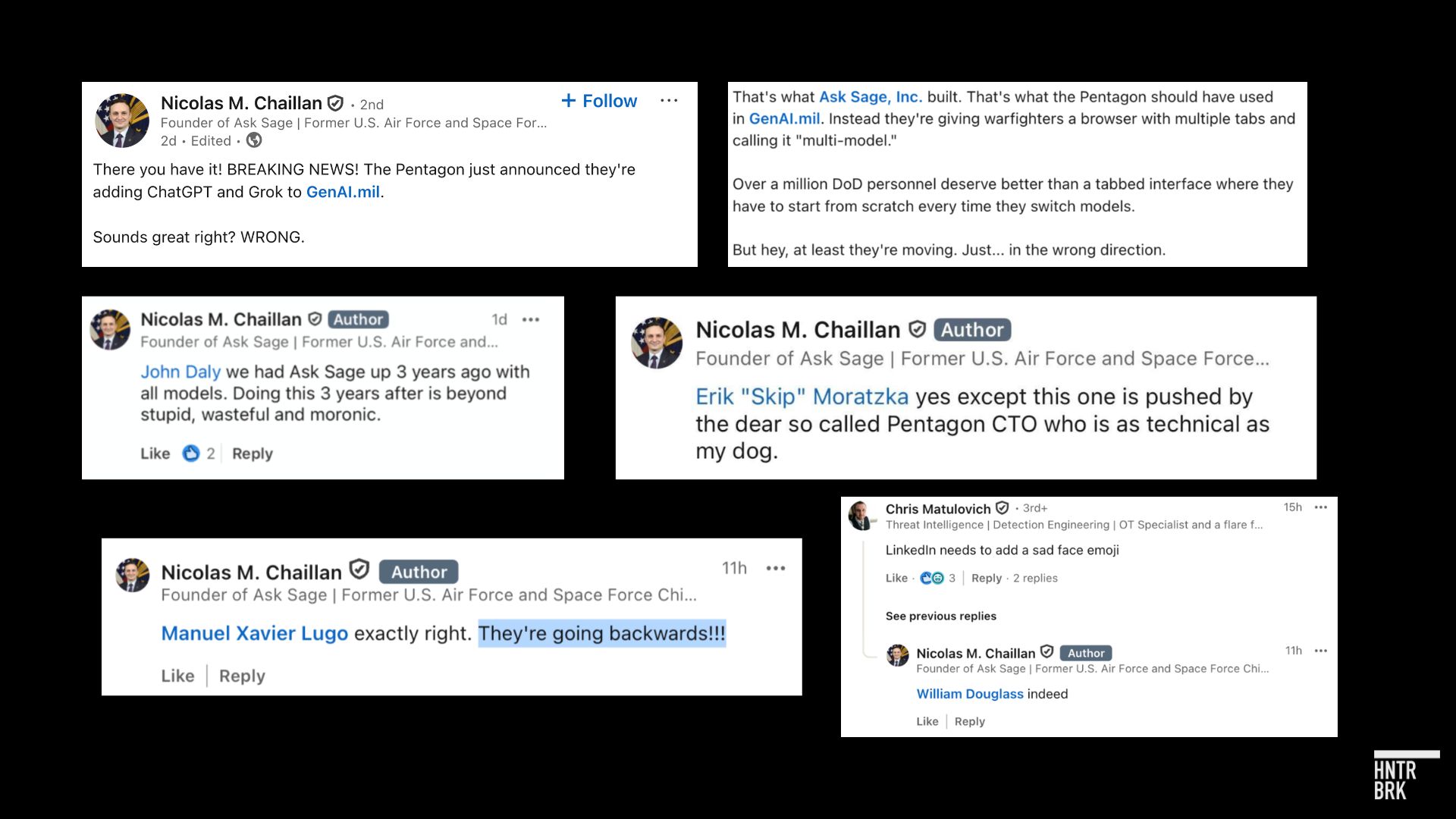
“BREAKING NEWS! The Pentagon just announced they’re adding ChatGPT and Grok to GenAI.mil.
Sounds great right? WRONG.”
So says Nicolas M. Chaillan, who was named the chief technology officer of BigBear.ai ($BBAI) after announcing he would sell the defense contractor his start-up, Ask Sage, for $250 million in November. Twenty-nine days after BigBear’s acquisition was announced, the Pentagon launched a free alternative that seemingly does much the same thing.
In a comment, Chaillan called the launch “beyond stupid, wasteful and moronic,” admonishing the Pentagon’s CTO for being “as technical as my dog.” The federal government is responsible for the majority of BigBear’s revenue.
The timing was, admittedly, tough for BigBear.
BigBear publicized the acquisition of Ask Sage on November 10 — agreeing to pay a quarter billion in cash for a generative AI platform tailored to the military. It was, apparently, BigBear’s largest-ever acquisition.
Just weeks later, on December 9, the Pentagon launched its competing platform, GenAI.mil — with Defense Secretary Pete Hegseth issuing a top-down mandate instructing all 3 million Department of Defense personnel to use it.
As of February 2, five out of six military branches have formally designated GenAI.mil as their enterprise AI platform, sidelining legacy tools that include Ask Sage, according to the military news outlet DefenseScoop.com. The sixth is the Coast Guard, which is piloting a separate product. The new GenAI.mil platform has allegedly already surpassed 1.1 million unique users.
Then, this week, the Pentagon announced it will add OpenAI’s ChatGPT to GenAI.mil, joining Google’s Gemini. xAI’s Grok is also reportedly in the mix. (Anthropic is, reportedly, hesitant to agree to the government’s “all lawful uses” clause.)
For BigBear, this came at a difficult moment.
The company announced the Ask Sage deal alongside a third-quarter earnings report that showed revenue down 20%, margins compressing, and full-year guidance cut by as much as $40 million from its original outlook. But investors seemingly supported the Hail Mary acquisition, so the stock temporarily popped.
BigBear had essentially bet its future on Ask Sage, spending the equivalent of half the cash on its balance sheet to purchase Ask Sage at 10 times the startup’s 2025 annual recurring revenue.
“We look to our acquisition of Ask Sage to support accelerating our growth into 2026 and beyond,” said BigBear’s CEO, who highlighted Ask Sage’s over 100,000 government users.
The problem: At the time, it was not publicly known that the Pentagon itself would be releasing a competitor to Ask Sage, in partnership with some of the biggest companies in the world.
A month later, GenAI.mil reportedly already has about 11 times as many people on its platform. And Chaillan — Ask Sage founder, newly named BigBear CTO — is, apparently, Big Mad.
Chaillan has repeatedly posted about GenAI.mil on LinkedIn — lamenting that the platform did not integrate various models as effectively as Ask Sage.
“Over a million DoD personnel deserve better than a tabbed interface where they have to start from scratch every time they switch models,” he wrote.
“But hey, at least they’re moving. Just… in the wrong direction.”
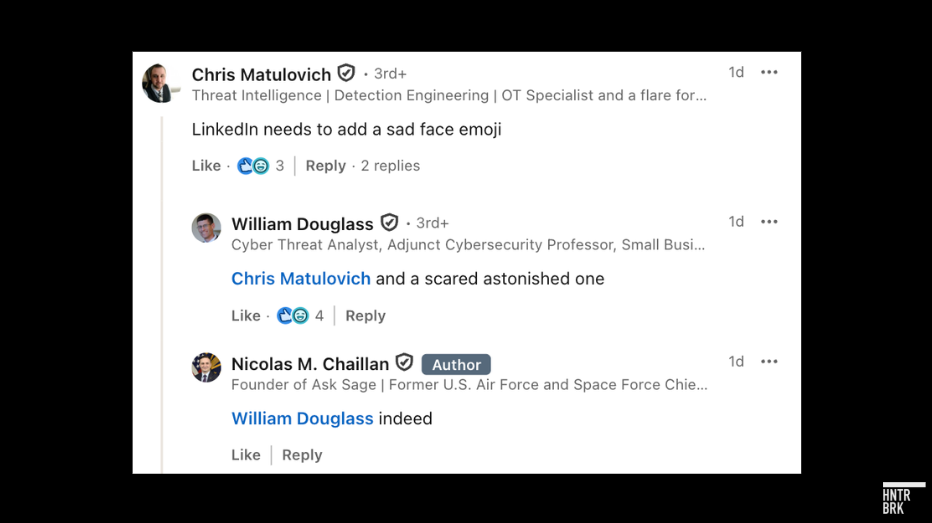
One commenter replied: “LinkedIn needs to add a sad face emoji,” prompting another to lament: “and a scared astonished one.”
Chaillan’s response? “Indeed.”
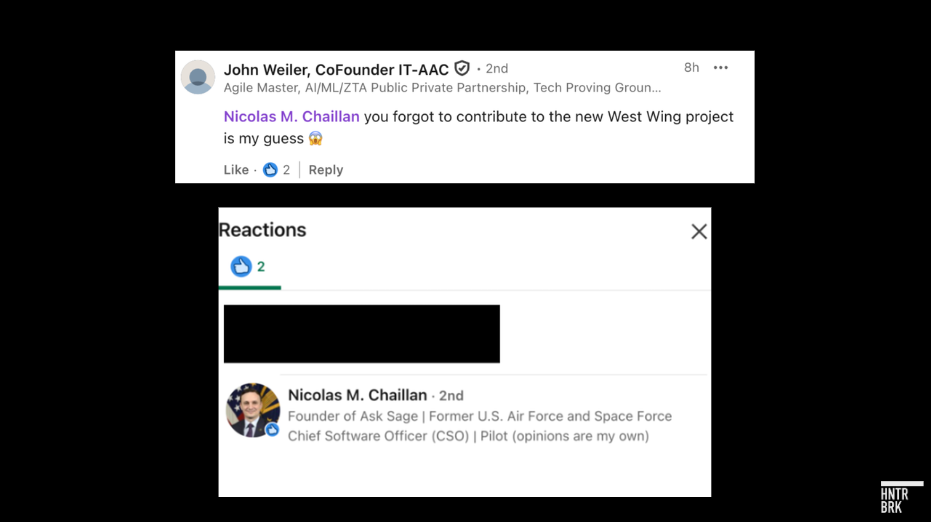
A different commenter implied Chaillan — and, consequently, BigBear — was being punished for not bribing the administration.
“@Nicholas M. Chaillan you forgot to contribute to the new West Wing project is my guess.”
Chaillan didn’t reply to this comment — but he did like it.
Around this same time, Reddit observers pointed out that Chaillan appears to have removed BigBear from his LinkedIn job title. Asked for an explanation, BigBear declined to provide Hunterbrook with a comment. Nor did Chaillan himself, who ghosted a Hunterbrook reporter on LinkedIn, despite clearly being, ah, quite active (!) on the platform.
Sign Up
Breaking News & Investigations.
Right to Your Inbox.
No Paywalls.
No Ads.
What BigBear.ai Bought — and Why
When BigBear.ai announced its agreement to acquire Ask Sage, the company framed the deal as transformational. CEO Kevin McAleenan called it an accelerant that would position BigBear.ai for “leadership in our core national security market.”
Chaillan — the former first chief software officer of the U.S. Air Force — founded Ask Sage in 2023. The startup built its brand around serving the defense AI market. The platform’s key selling points: It was branded as model-agnostic, running multiple large language models under the hood to cross-check answers. And it claimed to hold an authorization called FedRAMP High, plus an ability to handle DoD Impact Level 5, IL6, and Top Secret information.
The crown jewel was Ask Sage’s role in powering the Army Enterprise LLM Workspace, launched under a $49 million, five-year IDIQ contract. The Pentagon’s Chief Digital and Artificial Intelligence Office awarded Ask Sage an additional $10 million in June 2025 to expand the platform to combatant commands, the Joint Staff, and the Office of the Secretary of Defense.
Between the two contracts, it wasn’t much revenue — $60 million total over five years — but BigBear paid $250 million for Ask Sage anyway. And on paper, it wasn’t necessarily crazy: It looked like a floundering company making an expensive purchase to buy its way into a burgeoning defense tech growth vector.
Then, BigBear’s primary customer, the Pentagon, partnered directly with the LLM providers powering Ask Sage, including Google, to create what is essentially a competitor.
The Pentagon’s Internal Competitor
A month after BigBear.ai announced the Ask Sage deal, the Pentagon launched GenAI.mil, a centralized platform to deliver commercial AI models directly to the entire workforce.
“For the first time ever, by the end of this week, 3 million employees, warfighters, and contractors are going to have AI on their desktop, every single one,” Pentagon Chief Technology Officer Emil Michael — also known for threatening a journalist and her family as an exec at Uber — announced at the launch.
Defense Secretary Hegseth followed with a directive ordering personnel to “log in, learn it, and incorporate it into your workflows immediately.”
Google’s Gemini for Government was the first model to go live for handling sensitive but unclassified data. The Pentagon holds $200 million contracts with each of four frontier AI companies — Google, OpenAI, Anthropic, and xAI. On Monday, the Department formally announced its partnership with OpenAI to bring ChatGPT to GenAI.mil.
The adoption velocity has been impressive. Within two months, GenAI.mil hit 1.1 million unique users, according to DefenseScoop, and achieved what the Pentagon claims is 100% uptime since launch.
Five of Six Branches Using GenAI.mil
On February 2, DefenseScoop reported that five of six military branches had formally elevated GenAI.mil as their enterprise AI platform. The service-by-service breakdown of their reporting paints a stark picture of how quickly Ask Sage’s addressable market is eroding.
The Navy went furthest, with a spokesperson telling DefenseScoop that the sea service “has designated GenAI as the mandated platform for mission owners and all Department of the Navy users.” That word — mandated — is tough for any competing platform.
The Marine Corps officially designated GenAI.mil as its preferred LLM platform, authorized for all Marines, civilians, and contractors. The service’s AI lead called it “the first true enterprise solution for Marines to use generative AI.”
The Air Force sunsetted its homegrown NIPRGPT chatbot — which had over 700,000 users across the DoD — on December 31, 2025, in favor of GenAI.mil. Users were given just three weeks to transition. The Air Force and Space Force have both formally adopted GenAI.mil as their enterprise platform.
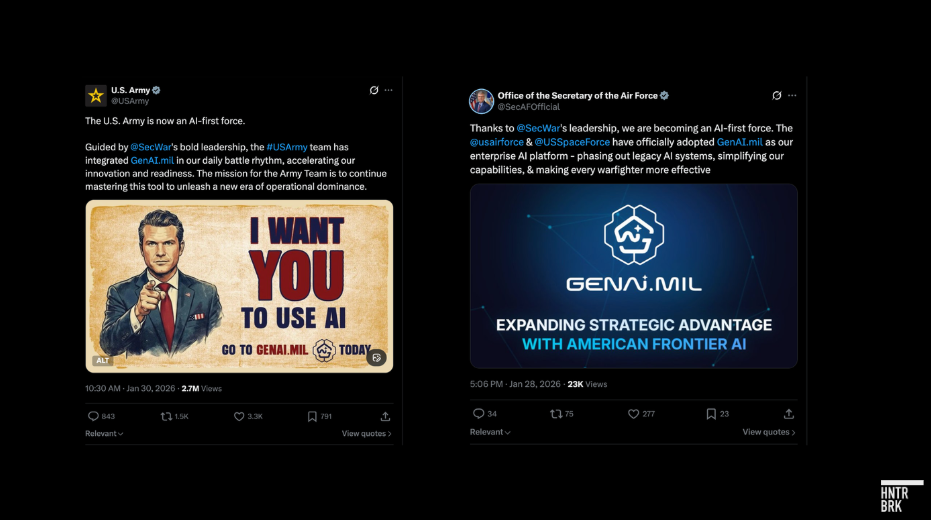
The Army declared itself an “AI-first” organization turning to GenAI.mil, though it has said it will not completely cut off access to preexisting AI tools — which includes the Ask Sage-powered Enterprise LLM Workspace.
The Coast Guard is apparently the sole holdout, developing its own prototype called “Ask Hamilton,” which does not have any apparent relationship with Ask Sage.
The military did not respond to Hunterbrook’s request for comment.
Ask Sage Hanging On
Ask Sage may retain some defensible territory — for now.
Its alleged authorization at Impact Level 6 and Top Secret gives it access to classified environments that GenAI.mil, limited to IL5 as of two months ago, cannot yet reach. And its “Ask Sage Edge” product purportedly serves disconnected, degraded, and intermittent environments — forward operating bases and maritime command centers where cloud-based platforms can’t operate.
The Army’s decision to maintain access to its existing AI tools, including the Ask Sage-powered Enterprise LLM Workspace, provides a near-term revenue backstop. The $49 million IDIQ contract runs for five years, and existing task orders don’t vanish overnight, though they, alone, don’t explain a $250 million valuation.
And Chaillan, for one, isn’t acting like all is well and good.
In a totally separate LinkedIn post, he accused the Air Force of retaliating against him: “A DISGRACE!”
The retaliation, he argued, was for publicly resigning from the Air Force in 2021 with a blistering public letter warning that the Pentagon was too slow to adopt new technology.
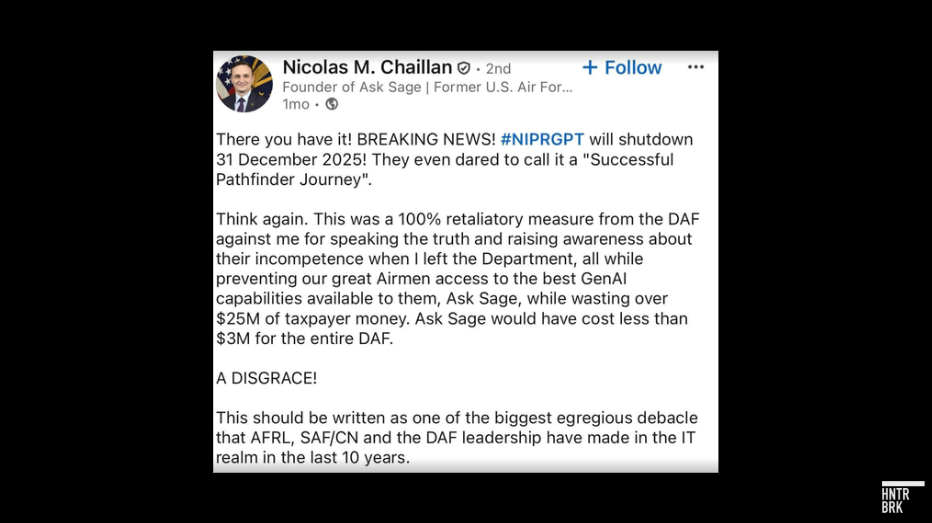
The irony: Four years later, the Pentagon moved fast enough to create an alternative to his product before the acquisition ink was dry.
Authors
Sam Koppelman is a New York Times best-selling author who has written books with former United States Attorney General Eric Holder and former United States Acting Solicitor General Neal Katyal. Sam has published in the New York Times, Washington Post, Boston Globe, Time Magazine, and other outlets — and occasionally volunteers on a fire speech for a good cause. He has a B.A. in Government from Harvard, where he was named a John Harvard Scholar and wrote op-eds like “Shut Down Harvard Football,” which he tells us were great for his social life.
Blake Spendley joined Hunterbrook from the Center for Naval Analyses (CNA), where he led investigations as a Research Specialist for the Marine Corps and US Navy. He built and owns the leading open-source intelligence (OSINT) account on X/Twitter, called @OSINTTechnical (over 1 million followers), which also distributes Hunterbrook Media reporting. His OSINT research has been published in Bloomberg, the Wall Street Journal, and The Economist, among other top business outlets. He has a B.A. in Political Science from USC.
Editor
Wendy Nardi joined Hunterbrook after working as a developmental and copy editor for academic publishers, government agencies, Fortune 500 companies, and international scholars. She has been a researcher and writer for documentary series and a regular contributor to The Boston Globe. Her other publications range from magazine features to fiction in literary journals. She has an M.A. in Philosophy from Columbia University and a B.A. in English from the University of Virginia.
Hunterbrook Media publishes investigative and global reporting — with no ads or paywalls. When articles do not include Material Non-Public Information (MNPI), or “insider info,” they may be provided to our affiliate Hunterbrook Capital, an investment firm which may take financial positions based on our reporting. Subscribe here. Learn more here.
Please contact ideas@hntrbrk.com to share ideas, talent@hntrbrk.com for work opportunities, and press@hntrbrk.com for media inquiries.
LEGAL DISCLAIMER
© 2026 by Hunterbrook Media LLC. When using this website, you acknowledge and accept that such usage is solely at your own discretion and risk. Hunterbrook Media LLC, along with any associated entities, shall not be held responsible for any direct or indirect damages resulting from the use of information provided in any Hunterbrook publications. It is crucial for you to conduct your own research and seek advice from qualified financial, legal, and tax professionals before making any investment decisions based on information obtained from Hunterbrook Media LLC. The content provided by Hunterbrook Media LLC does not constitute an offer to sell, nor a solicitation of an offer to purchase any securities. Furthermore, no securities shall be offered or sold in any jurisdiction where such activities would be contrary to the local securities laws.
Hunterbrook Media LLC is not a registered investment advisor in the United States or any other jurisdiction. We strive to ensure the accuracy and reliability of the information provided, drawing on sources believed to be trustworthy. Nevertheless, this information is provided "as is" without any guarantee of accuracy, timeliness, completeness, or usefulness for any particular purpose. Hunterbrook Media LLC does not guarantee the results obtained from the use of this information. All information presented are opinions based on our analyses and are subject to change without notice, and there is no commitment from Hunterbrook Media LLC to revise or update any information or opinions contained in any report or publication contained on this website. The above content, including all information and opinions presented, is intended solely for educational and information purposes only. Hunterbrook Media LLC authorizes the redistribution of these materials, in whole or in part, provided that such redistribution is for non-commercial, informational purposes only. Redistribution must include this notice and must not alter the materials. Any commercial use, alteration, or other forms of misuse of these materials are strictly prohibited without the express written approval of Hunterbrook Media LLC. Unauthorized use, alteration, or misuse of these materials may result in legal action to enforce our rights, including but not limited to seeking injunctive relief, damages, and any other remedies available under the law.